





Home / Functional Web Design / Case Studies & Successes / How We Built 21.5X Shopify Sales Growth for UltraTrack
 Written by
 Ecommerce growth guide
Better discovery and clearer buying decisions made every traffic source more valuable
Ultra Track & Tire, known as UltraTrack, sells rubber tracks and undercarriage parts for compact construction equipment. Bless Web Designs connected website strategy, product discovery, an AI shopping agent, conversion rate optimization, search engine optimization, Google Ads, and Meta Ads into one customer journey. Monthly Shopify sales grew 21.5X from the last full prelaunch month to the latest full month.
Shopify redesign
Product Finder
AI shopping agent
CRO
SEO
Google Ads
Meta Ads
Product Finder
AI shopping agent
CRO
SEO
Google Ads
Meta Ads
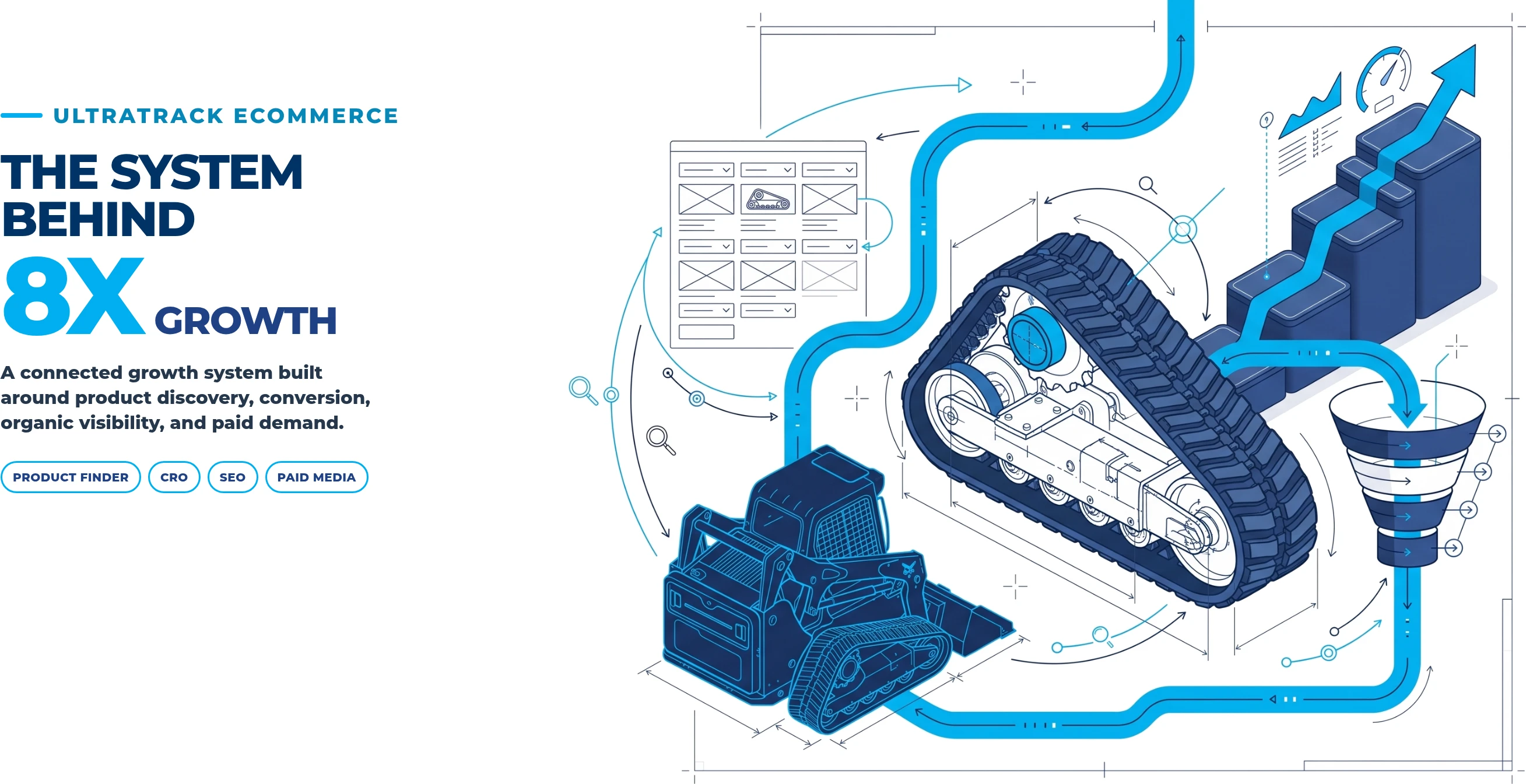
The short answer: UltraTrack did not rely on one campaign or one design change. The website redesign improved the buying path. The Product Finder reduced fitment uncertainty. The AI shopping agent answered visitors and guided them toward relevant products. CRO strengthened clarity and trust. SEO expanded relevant discovery. Google Ads captured active demand. The Meta rebuild improved purchase focused delivery. Together, those improvements helped monthly Shopify sales grow 21.5X.
21.5XMonthly Shopify sales growth from the last full prelaunch month to the latest full month
10.57XGoogle Ads return on ad spend
27.92XCumulative Meta return on ad spend after rebuild
8XSearch and AI attributed revenue
+23%Conversion lift from the AI shopping agent
+42.6%Google Search impressions
21XVisits from ChatGPT
How to read the results: Shopify shows overall store growth. Google Ads and Meta Ads report channel return on ad spend. Search and AI attributed revenue is a separate analytics view. Keeping those measures separate makes the business result and each channel result easier to understand.
The central lesson
Overall sales growth comes from a system, not a single channel
An ecommerce store creates revenue through a chain of decisions. A buyer must discover the business, recognize a relevant product, confirm compatibility, trust the seller, understand the next step, and complete the purchase. A weak link anywhere in that chain limits the whole result.
Overall ecommerce result
Monthly Shopify sales moved into a much higher range
21.5X growth
The index uses the last full prelaunch month as 1.00. It shows overall Shopify sales growth without mixing sales with channel attribution.
1.08XQualified visits
×
3.49XConversion rate
×
2.13XOrder value
=
8XAttributed revenue
This equation explains the Search and AI attributed result, which is one part of the larger Shopify growth story. Qualified visits grew modestly, but the value created by those visits changed dramatically. More visitors completed orders, and the average order value increased. The same audience became more productive because the buying experience answered better questions at better moments.
That is the compounding effect of ecommerce work. SEO can bring a relevant person to a product category. A Product Finder can narrow the catalog. Clear specifications can confirm fitment. Warranty and shipping information can reduce risk. A strong product page can convert the visit. Better purchase data can then help advertising platforms find more people with similar intent.
The connected system
Seven parts. One buying journey.
Each part removed a different barrier between a qualified buyer and a confident purchase.
- Shopify redesign
- Product Finder
- AI shopping agent
- Conversion design
- Ongoing SEO
- Google Ads
- Meta Ads
Understand the buyer
Industrial ecommerce is not ordinary online retail
A person buying a rubber track for a compact track loader or mini excavator is not browsing for entertainment. The machine may be out of service. The part must fit. Delivery timing matters. A wrong choice can create lost work, return costs, and more downtime.
01
Fitment risk
The buyer needs confidence that dimensions, tread, make, model, OEM part number, or serial number lead to the correct product.
02
Downtime pressure
Delivery and processing information are not minor details. They help an equipment owner estimate when the machine can return to work.
03
High consideration
The order can be substantial, so warranty, fitment assurance, support, and seller credibility carry more weight.
04
Technical language
Buyers search with machine names, track sizes, OEM numbers, and application terms. The site must understand those entities.
05
Multiple routes
Some buyers know the exact part. Others only know the machine. The store needs routes for both levels of knowledge.
06
Human reassurance
A visible phone number and expert help remain important when the buyer wants confirmation before placing the order.
The conversion question is bigger than “Do they like the page?”
The real questions are: “Can I find the right track, can I verify it, can I trust the seller, and can I get help before this decision costs me more downtime?” The redesign was built around those questions.
Foundation one
The redesign created a clearer route from need to product
The website redesign and Product Finder launched together. Conversion improvements were included in the structure, copy, hierarchy, and interaction design rather than added as a cosmetic layer later.
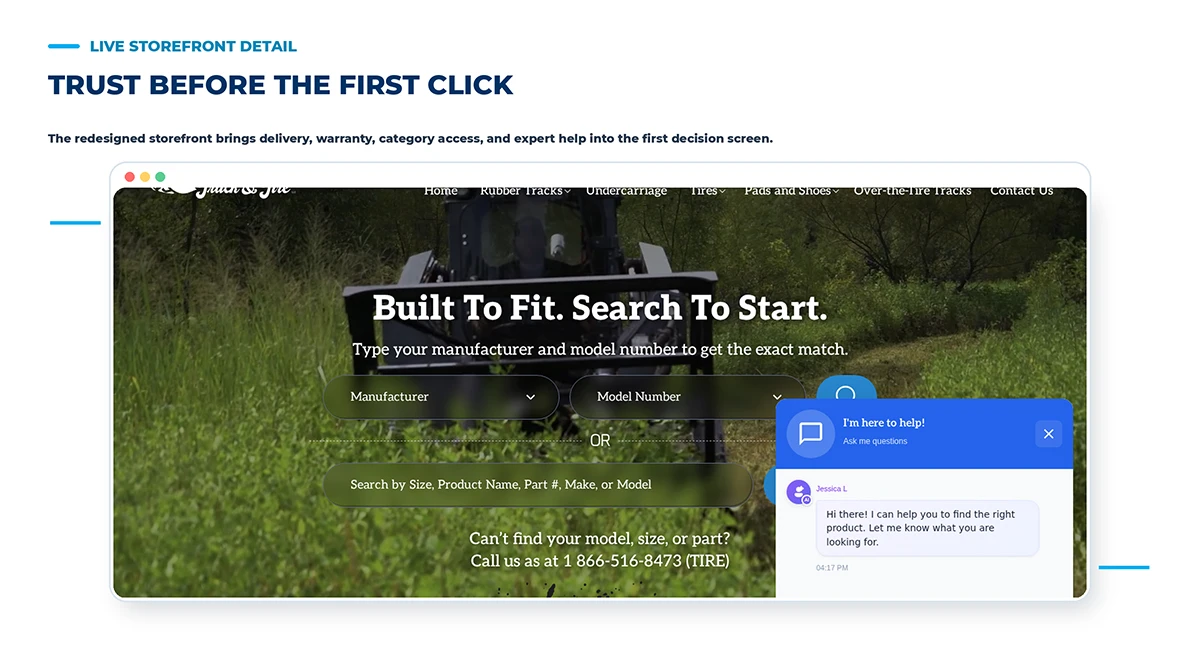
What changed in the first decision screen
The first screen has a simple job: help the right buyer understand the offer and choose a useful next step. UltraTrack presents product categories, the Product Finder, phone support, and purchase benefits early. Free shipping to the lower 48 states, same day processing before the stated cutoff, shipping from 17 warehouses, and a 30 month warranty on rubber tracks turn operational facts into buying confidence.
| Design action | Buyer benefit | Business effect |
|---|---|---|
| Lead with product discovery | The buyer can search by machine or known part information. | More qualified visitors reach a relevant product path. |
| Show core categories clearly | Rubber tracks, undercarriage parts, tires, pads and shoes, and over the tire tracks are easier to distinguish. | Fewer visitors get lost in a large catalog. |
| Place trust benefits early | Shipping, processing, and warranty questions receive early answers. | Less hesitation before product exploration. |
| Keep expert help visible | A buyer can call when fitment needs human confirmation. | Uncertain visitors have a recovery path instead of leaving. |
| Use a strong visual hierarchy | Headlines, search controls, buttons, and supporting details are easier to scan. | The next action requires less thought and less effort. |
Why this affects revenue
A redesign improves revenue when it improves decisions. Cleaner typography alone cannot do that. The page must connect a buyer question to the next useful answer. Every reduced dead end increases the chance that qualified traffic reaches a category, a matching product, a support conversation, or the cart.
Foundation two
The Product Finder turned catalog complexity into a guided decision
Product discovery is part of conversion rate optimization. This is especially true when compatibility determines whether a purchase succeeds. UltraTrack needed more than a generic site search because different buyers arrive with different information.
Product discovery
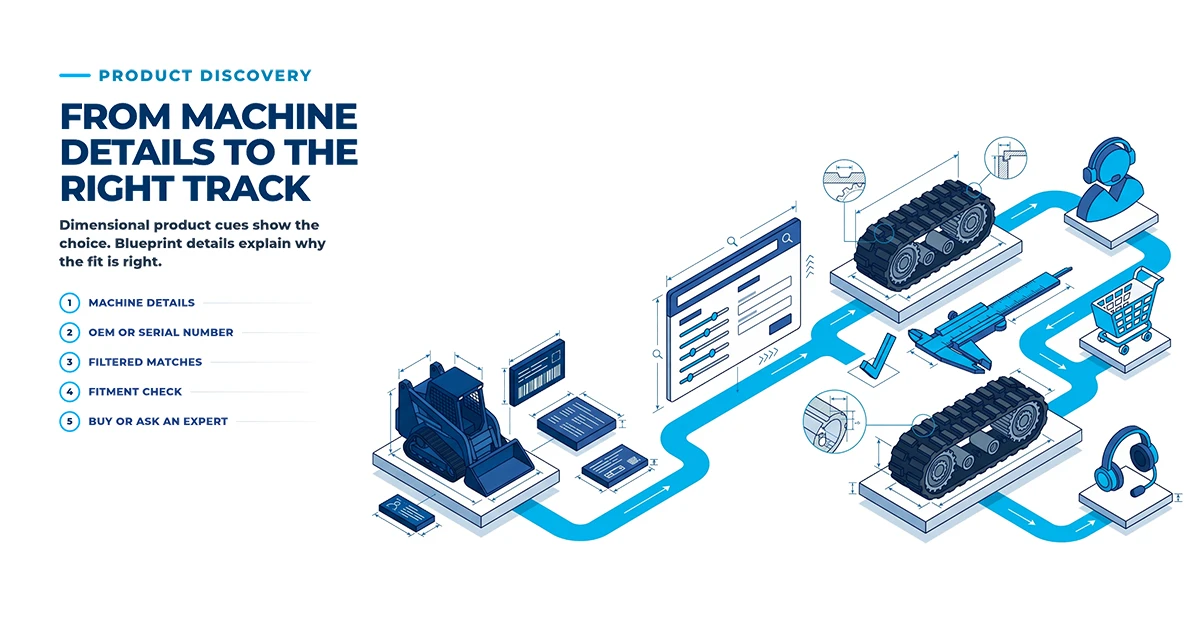
From machine details to the right track
Guided search reduces catalog friction and makes compatibility easier to confirm.
- Machine details
- OEM or serial number
- Filtered matches
- Fitment check
- Buy or ask an expert
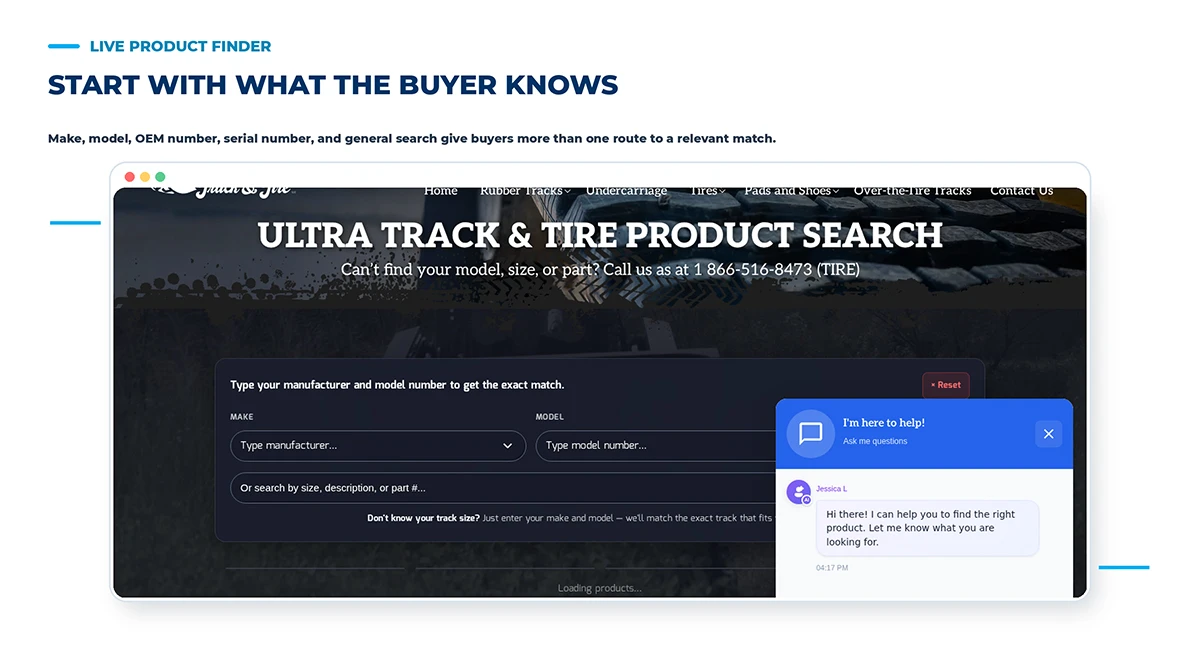
Start with known information
Make, model, size, description, OEM part number, or serial number can become the starting point.
Narrow the catalog
The interface reduces a large product set to options that are more relevant to the machine or identifier.
Complete or recover
A confident buyer can continue. An uncertain buyer can call for help instead of reaching a dead end.
Five ways a Product Finder can improve ecommerce performance
- It reduces search effort.The visitor does not need to understand the entire catalog structure before finding a relevant route.
- It reduces wrong fit anxiety.Machine and part identifiers make the decision feel grounded in compatibility rather than guesswork.
- It increases product page relevance.A visitor who reaches a product through a guided path arrives with stronger context and clearer intent.
- It creates useful intent data.Search patterns reveal which makes, models, sizes, and part numbers matter to real buyers.
- It saves uncertain demand.Expert help gives the visitor a next step when the finder cannot complete the decision alone.
For a large technical catalog, this is a revenue feature. It can improve conversion, reduce support friction, lower return risk, and help marketing teams understand the language customers use.
Conversational commerce
The AI shopping agent answers visitors and guides them to the right product
The Product Finder helps buyers who are ready to use structured fields. The AI shopping agent supports visitors who want to ask a question in their own words. Bless Web Designs created the agent to explain options, interpret product needs, recommend a relevant next step, and bring in human help when the decision needs expert confirmation.
Conversational commerce
AI guidance from question to the right product
The agent answers visitors, interprets machine and part details, recommends relevant products, and brings in human help when needed.
+23%Conversion lift
- Ask
- Interpret
- Recommend
- Buy or get help
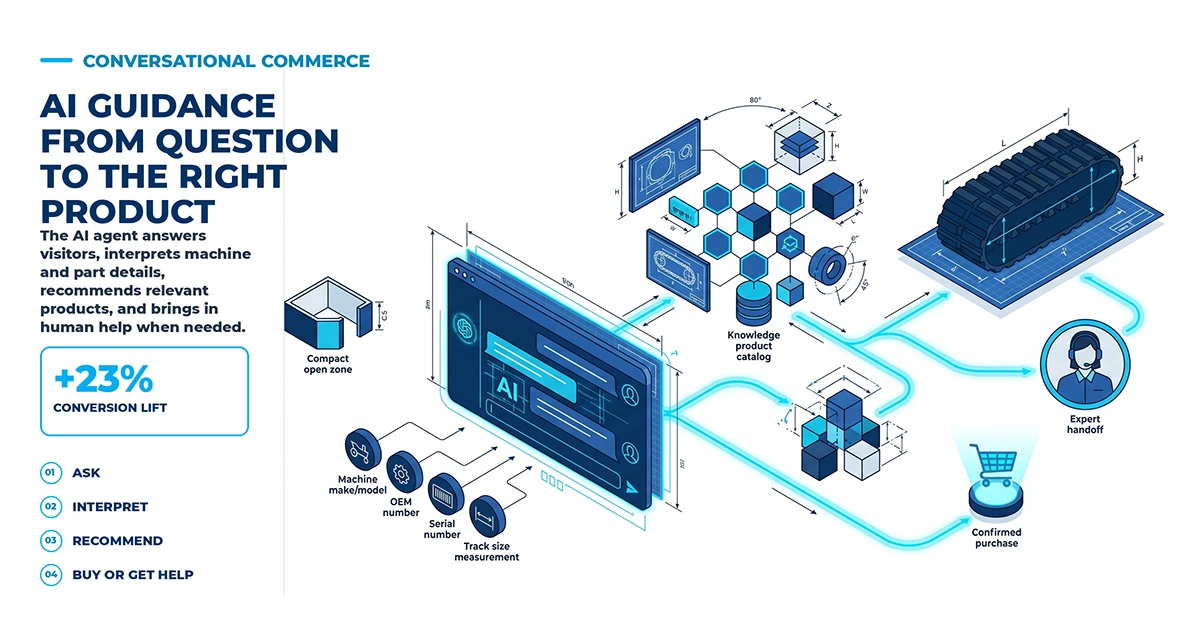
The AI shopping agent increased conversion by 23 percent. The lift came from helping visitors get useful answers while their buying intent was active, then guiding them toward a product or support route instead of leaving them to search the catalog alone.
How the AI product guidance journey works
- The visitor asks a natural question.The conversation can begin with a machine make and model, an OEM part number, a serial number, a track size, a product question, or uncertainty about what to choose.
- The agent interprets the buying need.It identifies the important details in the question and asks for missing information that can change fitment or product relevance.
- The agent connects the question with catalog knowledge.Product data, machine relationships, fitment information, store policies, and support guidance help shape the answer.
- The visitor receives a useful recommendation.The answer explains the relevant option and moves the visitor toward a product page, the Product Finder, or another helpful resource.
- Human help remains part of the path.Questions that need confirmation can move to an expert instead of forcing the agent to guess or allowing the visitor to leave.
- The journey continues toward purchase.The visitor can review the recommended product, confirm fitment and benefits, add it to the cart, or request support.
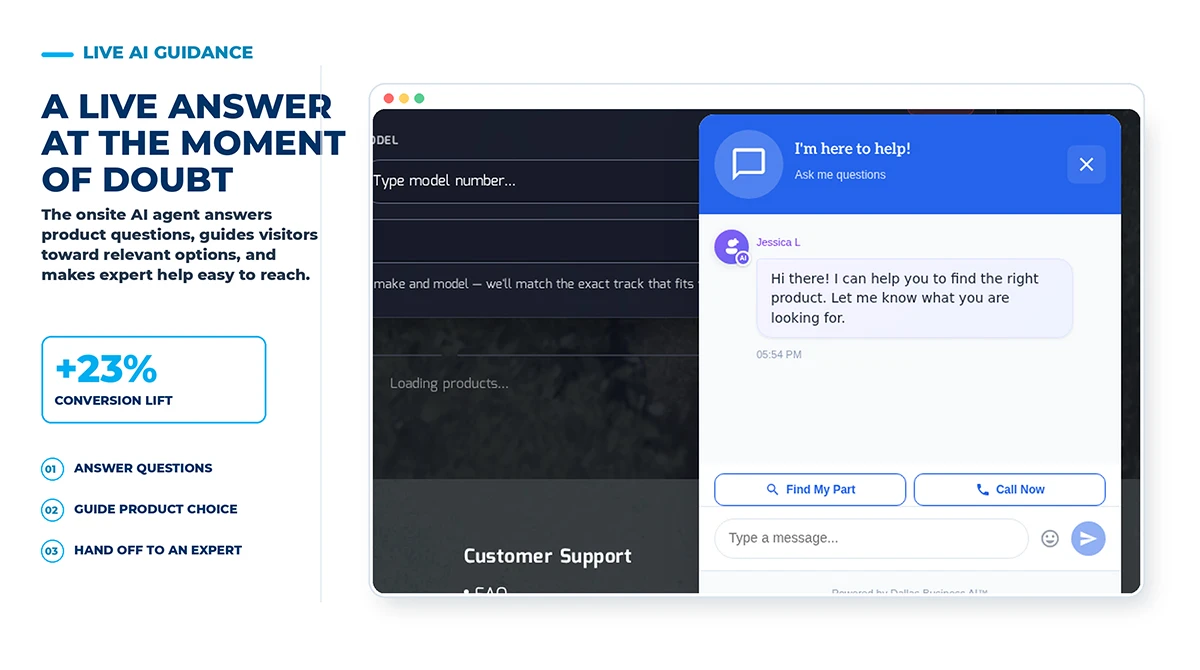
Why conversational guidance improves conversion
It meets the visitor at their knowledge level
A buyer does not need to know the site’s category structure or the exact product name before asking for help.
It answers questions while intent is active
Immediate guidance reduces the delay between uncertainty and an informed next step.
It makes a large catalog feel smaller
The conversation narrows attention to products and information related to the visitor’s actual need.
It reduces repetitive support friction
Common questions can receive consistent answers while the team remains available for decisions that need experience.
It protects fitment confidence
The agent can request key details and route uncertain situations to a person rather than presenting every product as an equal option.
It creates customer language insights
Real questions reveal the terms, objections, and information gaps that can improve pages, FAQs, SEO content, and campaigns.
The AI agent supports the sales team rather than replacing expertise
Technical ecommerce still needs clear limits and a human recovery path. The agent is most valuable when it gives fast, consistent guidance, recognizes uncertainty, and makes expert support easy to reach. That balance improves speed without sacrificing confidence.
Conversion rate optimization
The CRO checklist became a decision framework
The redesign drew from proven conversion principles, including the AIDA framework and a detailed ecommerce CRO checklist. The goal was not to add random badges or louder buttons. The goal was to match page content with the questions a buyer asks before acting.
Conversion blueprint
Answer the next question
A strong product journey follows a simple order: orient the buyer, verify fit, reduce risk, and make the next action obvious.
- OrientIs this relevant?
- Verify fitWill it match the machine?
- Build trustShipping, warranty, proof, support
- Make action clearBuy now or ask an expert
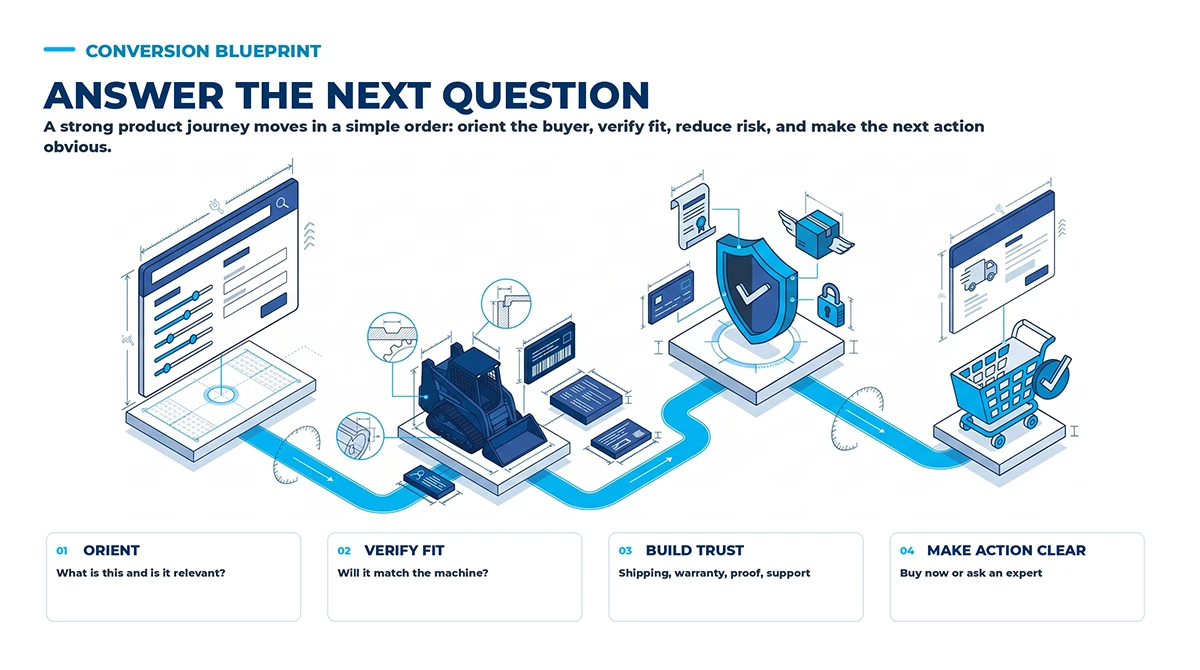
How AIDA translates to an industrial ecommerce store
A
Attention
Use the buyer’s language. Lead with rubber tracks, machine fitment, availability, and help rather than a vague company statement.
I
Interest
Give visitors a relevant path through categories, Product Finder controls, product imagery, and clear technical information.
D
Desire
Turn features into practical outcomes such as less downtime, correct fit, dependable processing, and warranty confidence.
A
Action
Make Find My Parts, Add to Cart, and expert support visible at the moment each action becomes useful.
Industrial ecommerce adds two important layers to AIDA: trust and friction reduction. Desire does not become action when the visitor still fears a wrong part, an unclear delivery window, or a difficult return. That is why fitment information, guarantees, support, and clear policies belong close to the conversion point.
The CRO actions applied across the experience
| Checklist area | What we did | How it can affect revenue |
|---|---|---|
| Value proposition | Made the product category, fitment help, shipping benefits, warranty, and support easier to see and understand. | Visitors can recognize relevance sooner and continue with more confidence. |
| Primary action | Used clear actions for product discovery, purchase, and expert help rather than giving every link equal visual weight. | A clear next step reduces decision effort and prevents qualified buyers from stalling. |
| Navigation | Organized the catalog around recognizable equipment and product categories. | Better information architecture helps more visitors reach commercial pages. |
| Search and filtering | Added guided search through machine details and direct identifiers. | Relevant products become easier to find, which can raise product page engagement and conversion. |
| Conversational guidance | Created an AI shopping agent that answers questions, interprets product needs, recommends a relevant route, and connects uncertain buyers with human help. | Visitors receive guidance while intent is active, contributing to a 23 percent conversion lift. |
| Benefit led copy | Connected store features with buyer outcomes such as confidence, speed, fit, and reduced downtime. | The offer becomes easier to evaluate than a list of technical claims alone. |
| Trust near action | Placed shipping, processing, warranty, fitment assurance, and support information near key decision areas. | Risk is answered before it becomes abandonment. |
| Product information | Improved the hierarchy of titles, specifications, fitment details, imagery, and supporting information. | Buyers can verify the product with less scanning and fewer support steps. |
| Pre sale questions | Used guides, FAQs, and support paths to answer common concerns before checkout. | Objections are resolved while buying intent is still active. |
| Mobile usability | Designed controls, search fields, buttons, and vertical content flow for smaller screens. | Mobile visitors can complete the same discovery and purchase tasks with less effort. |
| Cart confidence | Kept purchase benefits, payment clarity, and order context connected to the final action. | The cart feels like a continuation of the product decision rather than a new source of doubt. |
| Performance | Reduced unnecessary visual and code weight where possible and prioritized useful content. | Faster interaction protects conversion and supports organic visibility. |
| Measurement | Connected store, analytics, search, and advertising signals so changes could be evaluated by business outcome. | Future improvements can focus on the biggest constraint instead of personal preference. |
Why trust belongs beside the call to action
A call to action asks the visitor to accept risk. Supporting text helps reduce that risk. A fitment guarantee, warranty, delivery statement, review summary, or expert phone number can answer the final doubt that stands between product interest and purchase. Moving this information closer to the button shortens the mental distance between concern and answer.
Why mobile design matters for technical buyers
Equipment owners and operators may search from a job site, yard, truck, or workshop. Mobile design must support quick scanning, usable form fields, large tap targets, vertical content flow, and immediate access to a phone call. A desktop experience that merely shrinks onto a phone can hide the exact information needed to complete the order.
Page architecture
Every page has a different conversion job
A strong ecommerce website does not force every page to sell in the same way. Each page should answer the next question and move the buyer toward a more informed action.
| Page type | Primary job | Useful content | Next action |
|---|---|---|---|
| Homepage | Orient the buyer | Product categories, Product Finder, delivery benefits, warranty, reviews, and support | Choose a category or start a search |
| Collection page | Narrow the choice set | Equipment type, make, model, size, use, availability, and helpful filters | Open a relevant product |
| Product page | Confirm the decision | Fitment, dimensions, tread, imagery, price, shipping, warranty, FAQs, and support | Add to cart or ask an expert |
| Guide or resource | Teach and qualify | How to read track numbers, measure, compare options, and avoid fitment errors | Continue to a category, finder, or product |
| Cart | Preserve confidence | Selected items, clear totals, delivery context, payment methods, and trust | Proceed to checkout |
| Support path | Recover uncertainty | Phone number, contact route, machine details, and order help | Get a confirmed recommendation |
This page system also improves marketing quality. Search engines can connect specific queries with specific pages. Ads can point to a relevant category or product rather than a generic homepage. AI engines can retrieve direct passages from guides and product information. The AI shopping agent can then help the visitor move from a question to a product or support route. Customers can enter at different stages and still find a coherent path.
Ongoing discovery
SEO started with the redesign and continues as a growth program
Search engine optimization is not a one time launch task. The redesign created the technical and structural base. Ongoing SEO continues to expand useful pages, strengthen internal relationships, improve indexability, and match the language used by equipment owners and parts buyers.
Organic and AI discovery
Build pages that search systems can understand
Useful category, product, and support content created more ways for buyers to discover UltraTrack and confirm relevance.
+42.6%Google Search impressions
+64.1%Ranking keywords
18.6XReferring domains
21XChatGPT visits
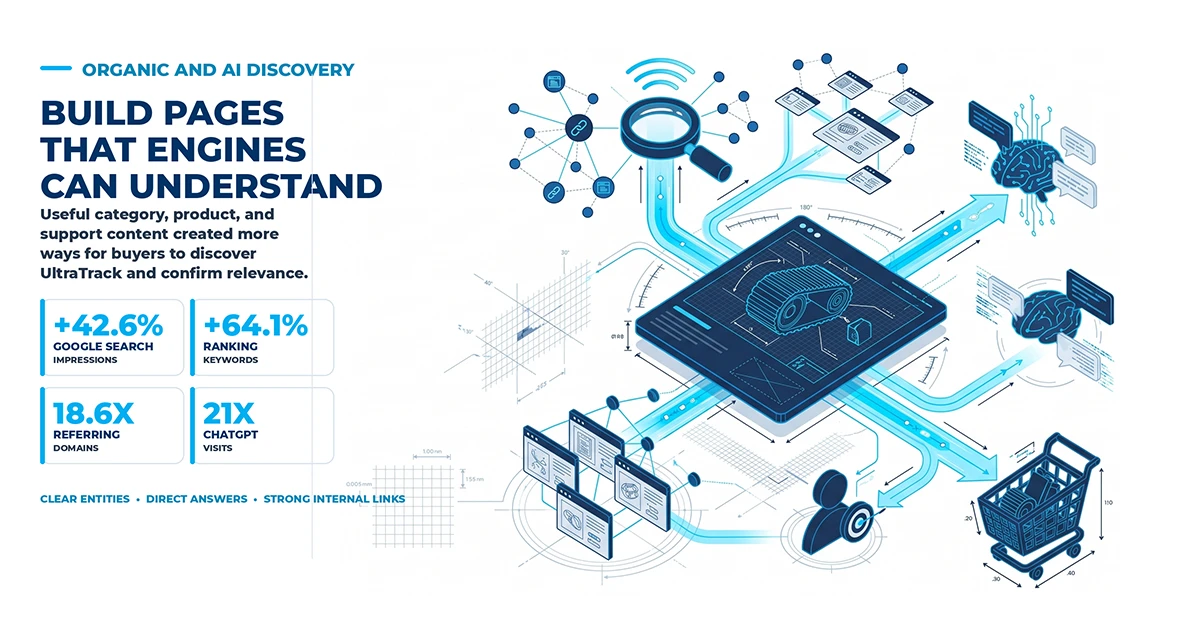
The SEO work has six connected layers
- Technical crawlability.Search engines need stable URLs, clean indexation, sensible canonicals, useful page speed, mobile usability, XML sitemaps, and internal links that expose important pages.
- Catalog architecture.Categories and collections need to reflect how buyers think about rubber tracks, undercarriage parts, equipment types, machine makes, models, and applications.
- Commercial page content.Collection and product pages need clear titles, descriptions, specifications, fitment details, shipping answers, warranty information, and related routes.
- Helpful resources.Guides can answer questions such as how to read rubber track numbers, how to measure a track, and how OEM numbers relate to replacement options.
- Entity relationships.Pages should make the relationship between a machine, manufacturer, model, part number, track size, tread pattern, product, and seller easy to understand.
- Authority and monitoring.Relevant links, referring domains, Google Search Console data, and ranking tools reveal where visibility is expanding and where better pages are still needed.
+42.6% search impressions
UltraTrack appeared in more Google Search results, which means the site gained a wider opportunity to be considered.
+64.1% ranking keywords
The measured keyword footprint expanded, creating more entry points across products, machines, and buyer questions.
18.6X referring domains
More unique websites linked to the domain, strengthening the range of external authority signals.
More impressions do not create revenue by themselves. A search result must lead to a relevant page, and that page must help the visitor act. UltraTrack’s 8X Search and AI attributed revenue is valuable because it connects discovery with conversion quality rather than treating rankings as the final goal.
Search and answer engines
Content for Google and AI engines still begins with useful answers
AI search visibility is often described as a new channel, but its strongest foundation is familiar: clear pages, reliable facts, accessible text, descriptive entities, original experience, and a site structure that helps systems retrieve the right answer.
What makes ecommerce content easier to understand and retrieve
- Use a direct answer near the start of the page.
- Name products, machines, models, part numbers, sizes, and applications clearly.
- Explain how the entities relate to one another.
- Use descriptive headings that match real buyer questions.
- Support claims with specifications, policies, examples, and first party experience.
- Keep important answers in visible HTML text.
- Link guides, categories, products, and support pages in a logical path.
- Use structured data that agrees with the visible page.
- Keep product availability, shipping, warranty, and business details consistent.
- Allow the crawlers needed for the discovery channels the business wants to reach.
Visits from ChatGPT grew 21X during the measured period. That does not replace Google Search, product feeds, or advertising. It shows that clear technical content can become discoverable in additional research journeys. A buyer may ask an AI system for compatible track information, measurement help, product differences, or a seller recommendation before visiting the store.
AI search and the onsite AI agent have different jobs
AI search can introduce UltraTrack during outside research. The onsite AI shopping agent continues the journey after the visitor arrives. One supports discovery. The other supports product understanding, fitment questions, recommendation, and conversion.
There is no useful shortcut called “AI copy”
Pages become useful to answer engines by becoming more useful to people. Clear facts, specific terminology, coherent internal links, accessible content, and genuine expertise are more durable than keyword repetition. Google explains that its normal search requirements remain relevant to AI features, and OpenAI documents OAI SearchBot for ChatGPT search visibility.
Capturing active demand
Google Ads became more efficient as intent and experience aligned
Paid search works best when the search term, ad promise, landing page, product availability, and conversion action tell one consistent story. Campaign optimization cannot repair a confusing store by itself. A stronger site gives every qualified click a better chance to become an order.
Paid search efficiency
Return on ad spend strengthened as intent and experience aligned
10.57X ROAS
The measured progression shows how qualified demand, tighter campaign intent, and a stronger landing experience began working together.
The paid search work focused on the full click journey
Query intent
Machine, product, size, and part related searches need to be separated from weak or unrelated traffic. Search term review and negative keywords protect budget quality.
Campaign structure
Product groups and intent themes create tighter control over ads, bids, landing pages, and the value of different demand.
Message match
The ad should describe the product or solution that the landing page immediately confirms. Strong message continuity reduces the feeling of a wrong click.
Landing page readiness
Product discovery, fitment details, trust benefits, mobile usability, and a clear action determine what happens after the click.
Purchase quality
Conversion count alone can mislead. Return on ad spend improves when the system finds orders with stronger value, not just more low quality events.
Learning loop
Search terms, products, conversions, and order patterns should feed back into SEO, page content, merchandising, and future campaigns.
Click through rate increased from 0.95 percent to 2.45 percent, a lift of about 158 percent. At the same time, Google Ads return on ad spend reached 10.57X. The important lesson is not that every business should chase the same number. The lesson is that traffic efficiency improves when campaign intent and onsite conversion work share the same commercial goal.
Paid social rebuild
The Meta rebuild optimized closer to completed purchases
The Meta setup was rebuilt around purchase optimization and catalog ads. That change gave the platform a business outcome closer to the final goal and connected ads with actual product data.
Purchase focused rebuild
The rebuilt campaigns produced stronger purchase economics
After rebuild
34.40XReturn on ad spend in the initial rebuilt period
27.92XCumulative return on ad spend after rebuild
3.07XHigher return on ad spend than the legacy setup
3XPurchases in the comparison period
57%Lower cost per click
| Signal | Change after rebuild | Why it matters |
|---|---|---|
| Click through rate | 1.91X | More people who saw the ads chose to visit. |
| Cost per click | 57 percent lower | The rebuilt setup produced site visits more efficiently. |
| Purchases | 3X | More completed orders came from the comparison period. |
| Return on ad spend achieved | 34.40X | The purchase focused campaigns produced substantially more attributed value than media cost. |
| Cumulative return after rebuild | 27.92X | The stronger return continued across the full rebuilt campaign window. |
| Return on ad spend improvement | 3.07X | The rebuilt setup delivered more than three times the return of the legacy comparison period. |
| Average order value | 2.39X | The rebuilt campaigns reached purchases with stronger order economics. |
Why purchase optimization changes the learning signal
An advertising platform learns from the event it is asked to find. An initiated checkout is useful, but it is not the same as a completed order. Purchase optimization moves the learning target closer to the business outcome. Catalog ads add product relevance by matching creative delivery with items, availability, and audience behavior.
The landing experience remains essential. Better targeting can introduce the right person, but the website still has to explain fitment, reduce risk, and make purchase or support easy. The Meta result therefore belongs to the same connected system as the redesign and CRO work.
The compounding effect
Each improvement changed the economics of the next one
Better discovery
SEO, Google Ads, Meta Ads, and AI referrals bring more relevant buyer intent to the store.
Better decisions
Navigation, Product Finder, AI guidance, content, fitment, trust, and support help the buyer move forward.
Better economics
Higher conversion and stronger order value make every qualified visit and media dollar more productive.
This is why isolated channel reporting can hide the real business lesson. SEO may assist an order that later returns through another source. A Google Ads click may convert better because the visitor previously read a guide. A Meta catalog ad may perform better because the product page answers fitment and shipping questions. The store is where channel promises become customer decisions.
Monthly Shopify sales grew 21.5X from the last full prelaunch month to the latest full month. Order volume grew by almost the same multiple across that comparison. This overall store growth sits alongside the 8X Search and AI attributed revenue result, 10.57X Google Ads return on ad spend, 27.92X cumulative Meta return on ad spend after the rebuild, and wider organic visibility. The pattern supports a clear conclusion: the business built a stronger ecommerce engine, not just a temporary traffic spike.
Apply the approach
A practical ecommerce growth playbook
The UltraTrack approach can be adapted to other ecommerce businesses with complex catalogs, considered purchases, technical products, or strong support needs.
- Define the buyer’s real task.Write down what the customer must identify, compare, verify, and trust before purchasing.
- Map every entry point.Include Google Search, paid search, social ads, AI referrals, direct visits, product feeds, and support conversations.
- Audit product discovery.Test navigation, site search, collection filters, Product Finder logic, AI guidance, no result states, and support recovery paths.
- Clarify the first screen.State what the store sells, who it serves, why the offer matters, and which action the visitor should take next.
- Place trust beside risk.Put shipping, warranty, fitment, returns, reviews, payment, and support information near the decision they protect.
- Give every page one primary job.Homepages orient, collections narrow, product pages verify, guides teach, carts preserve confidence, and support paths recover uncertainty.
- Write for entities and questions.Connect products with makes, models, part numbers, sizes, uses, problems, and related buyer language.
- Build internal pathways.Link guides to collections, collections to products, products to support, and related topics to one another.
- Align ads with landing pages.Use the same product, intent, promise, and action from search term or creative through the page.
- Optimize advertising for completed value.Use purchase quality and return on ad spend alongside clicks and intermediate events.
- Read channels together.Use Shopify, Google Analytics, Google Search Console, Google Ads, Meta Ads, and SEO tools as connected views of the same customer journey.
- Improve the largest constraint next.Traffic, product discovery, conversion, order value, and retention do not need equal attention at the same time.
How to find the current constraint
| Observed pattern | Likely constraint | Priority response |
|---|---|---|
| Relevant impressions rise but product visits stay weak | Search snippet or page targeting | Improve titles, descriptions, intent match, and internal routes. |
| Visitors search often but open few products | Catalog discovery | Improve finder logic, autocomplete, filters, and no result recovery. |
| Product views rise but cart activity stays weak | Product confidence | Strengthen fitment, benefits, imagery, reviews, shipping, warranty, and CTA hierarchy. |
| Cart activity rises but purchases stay weak | Checkout friction | Review totals, delivery clarity, payment methods, form effort, errors, and trust. |
| Ads drive clicks but return stays weak | Intent or landing quality | Tighten search terms, audiences, product groups, message match, and page relevance. |
| Conversion improves but growth remains limited | Qualified demand | Expand SEO content, product coverage, search campaigns, feeds, and remarketing. |
Client perspective
Industry understanding was part of the work
A useful ecommerce system cannot be designed from a generic template. The team needed to understand how equipment owners search, how fitment decisions are made, which questions signal uncertainty, and why delivery and support influence trust.
“We’ve had a great experience working with Bless Web Designs. Their team is responsive, easy to work with, and has taken the time to really learn and understand our industry. We really appreciate their communication, creativity, and dedication to helping our business grow. Highly recommend!”
The review points to an important growth principle: good execution begins with good discovery. Understanding the industry made it possible to design better search routes, use more relevant language, present the right trust information, and connect marketing with the way customers actually buy.
Frequently asked questions
Questions about ecommerce growth, CRO, SEO, and paid media
What created UltraTrack’s 21.5X Shopify sales growth?
The overall Shopify result grew as the redesign, Product Finder, AI shopping agent, CRO, SEO, Google Ads, and Meta Ads improved one connected buying journey. The 21.5X comparison uses the last full prelaunch month and the latest full month, so it measures storewide monthly sales growth rather than the return of one advertising channel.
What does the 8X Search and AI result mean?
The 8X figure refers specifically to tracked Search and AI attributed revenue. Qualified visits, a 3.49X conversion rate lift, and a 2.13X increase in average order value worked together within that attribution view. It is a supporting channel result, not the overall Shopify sales multiple.
How does a Product Finder improve ecommerce conversion?
A Product Finder translates information the buyer already knows, such as make, model, size, OEM number, or serial number, into a smaller and more relevant product set. It reduces search effort, fitment uncertainty, and dead ends while preserving a route to expert help.
How did the UltraTrack AI shopping agent improve conversion?
The agent answered visitors in natural language, interpreted machine and part details, recommended relevant product routes, and made human help available when confirmation was needed. That guided experience increased conversion by 23 percent.
What is ecommerce conversion rate optimization?
Ecommerce CRO is the structured improvement of a store so more qualified visitors complete a valuable action. It includes value proposition, product discovery, content hierarchy, trust, risk reduction, mobile usability, page performance, cart clarity, and measurement.
How do SEO and CRO work together?
SEO helps relevant people discover the right pages. CRO helps those people understand the offer, find a suitable product, resolve doubts, and act. Traffic creates more value when the buying path is clear.
Why do technical product pages need entity rich content?
Technical buyers and search systems need clear relationships between the product, manufacturer, machine, model, OEM part number, size, application, and seller. Specific language improves relevance and helps buyers verify the decision.
How can ecommerce content support AI search visibility?
Use direct answers, clear entities, consistent facts, accessible HTML, descriptive headings, useful internal links, original experience, and crawlable pages. AI search visibility grows from strong content and technical foundations, not keyword repetition.
Why can Google Ads improve after a website redesign?
A more relevant landing experience can improve the value of qualified clicks. Clear product paths, stronger message match, better mobile usability, trust, and easier purchase actions help advertising turn active demand into completed orders.
Why optimize Meta Ads for purchases instead of checkout starts?
A completed purchase is closer to the business goal. Training the platform toward that event can improve the quality of learning, especially when product catalog data and a strong landing experience support the campaign.
Which ecommerce metric should a business improve first?
Start with the largest constraint. A store with weak discovery needs a different priority from a store with strong traffic and low conversion. Review qualified demand, product discovery, product page engagement, cart progress, purchases, and order quality as one sequence.
About the businesses
UltraTrack and Bless Web Designs
UltraTrack
Ultra Track & Tire supplies rubber tracks, undercarriage parts, tires, pads and shoes, and over the tire tracks for compact construction equipment. Its ecommerce experience supports product discovery, fitment research, purchasing, and expert assistance.
Bless Web Designs
Bless Web Designs combines website strategy, custom design, ecommerce development, AI shopping agents, conversion planning, SEO, and paid media. The work centers on turning qualified attention into a clear and measurable customer journey.
Performance signals referenced in this guide come from UltraTrack’s Shopify, Google Analytics, Google Search Console, Google Ads, Meta Ads, Ahrefs, and Semrush reporting. Conversion work was informed by established AIDA and ecommerce CRO principles.
